
At some point, corruption stops being about money. It becomes about who gets to move forward, and more importantly, how the system is engineered to hold everyone else back.
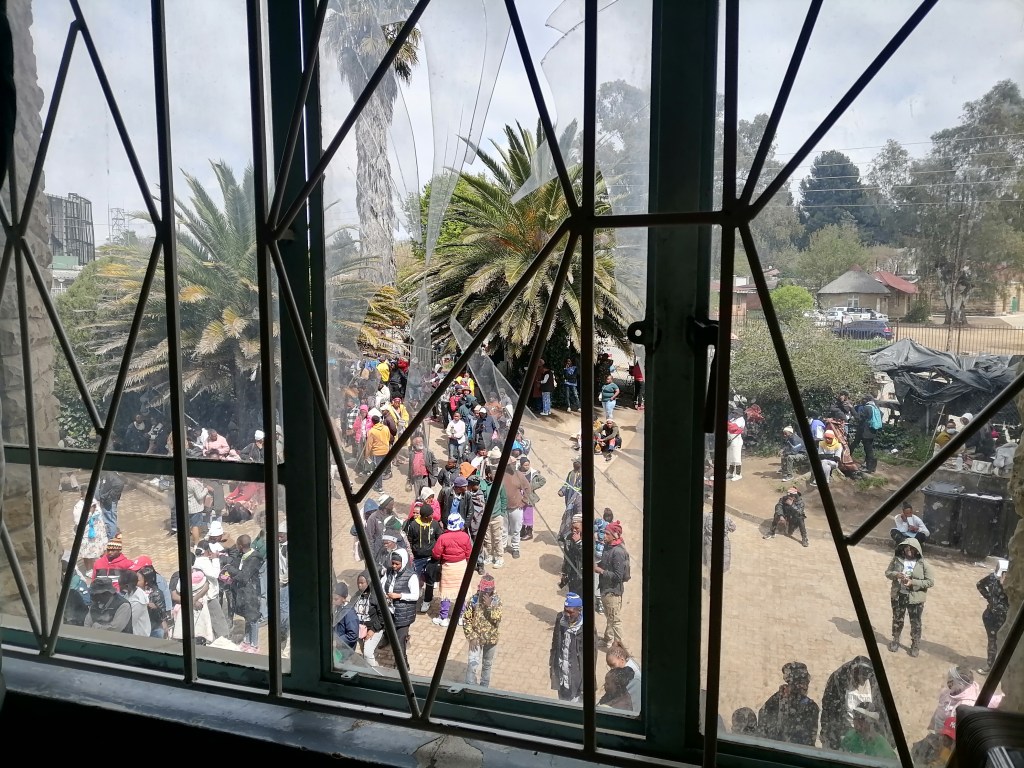
At 4:00 AM, while Maseru is still pitch black, the line outside the Ministry of Home Affairs is already forming. By 6:00 AM, you are applicant number 74. By 8:00 AM, if you’d just arrived, the scene looks chaotic. It resembles a very busy marketplace with seemingly endless, overlapping lines.
But look closer, and you realize this isn’t chaos. It is a highly efficient ecosystem of manufactured delay.
Two to three days later, after hours spent standing in static lines, enduring unexplained delays, and navigating hostile counters, you finally pay for a document that requires less than five minutes to fill out. When citizens finally receive their passport, the overwhelming emotion is not civic pride; it is the hollow relief of surviving a hostage situation.
The feeling of relief is akin to the jubilation of winning the lottery. You want to cry. Because honestly, what the hell?
It takes less time to secure a multi-million-maloti bank loan than it does to get a booklet proving who you are. So why does applying for a passport in Lesotho feel like an endurance test?
I remember calling an official beforehand. “How much for a regular passport?” I asked. “M130,” she said. “And how long will it take until I can receive it?” With a casual tone that could easily be confused for amusement, she replied, “It could take three days… or three months.”
The posters on the government walls promise delivery within three days. In reality, it takes three days simply to submit the application. On day one, you spend eight full hours in line just to pick up and complete a single piece of paper. On day two, you join another queue for the passport photo, standing under the sun for over five hours. A micro-economy has even sprung up around the misery, with locals renting out plastic chairs for M10 a day. Once the photo is taken, you join yet another line.
These queues aren’t just long; they are soul-crushing. On day two, I watched a man lose the last bit of light in his eyes. “I’m just thinking about work,” he said with a bitter smile. “I can’t be here again tomorrow. My boss is already questioning where I am.”
This isn’t just an administrative headache; it’s an issue of basic survival. Following anti-migration campaigns and rising hostility in South Africa, securing a passport is a lifeline for Basotho living and working across the border.
On what I believe was my third trip to the Manager’s Office, I was in disbelief. I didn’t go in out of arrogance, but out of sheer bafflement at the infrastructure. If a citizen is forced to wait eight hours in a single queue just for a photograph, we have to start asking questions about a Home Affairs system that feels deliberately stuck in the 1960s.
The Bottleneck Business Model
Let’s talk about the system itself. The spatial design alone is a massive bottleneck: four massive queues outside funnel into a single narrow staircase leading to one cramped room where three separate services are conducted simultaneously. There is barely any room.
We often look at this and call it incompetence. But what if it isn’t? What if this spatial design is a psychological tool? Exhaust the citizen, strip them of their dignity before they even reach the counter, and they will become desperate enough to pay anything just to escape.
In an era where you can open a bank account from a smartphone, we are still forcing people to stand in line for a physical form. Why? Because a digital system doesn’t take bribes. You cannot slip a M100 note to an online PDF. By refusing to modernize, the system preserves the analog bottlenecks that make extortion possible. The inefficiency doesn’t feel like a bug; it feels like a core feature.
This is an experience I would love for a high ranking official in government to endure for two full days. No security detail, no VIP privileges, no shade, no benches. Experience it like an everyday Mosotho, just time dragging on while feeling an ache in your feet that you’re too proud to admit, trapped in a building that seems designed to punish you for existing.
The Economy of the Queue
At Home Affairs, there is the official price, and then there is the price of not waiting.
“Ngoana oa Molimo..” What a foolish woman. She actually thinks the system works. That’s the part that hurts the most. Because somewhere along the way, we have normalized the idea that if you don’t pay someone to help you navigate a public service, you are not honest. You are simply stupid.
I’ve been told the stories of slapping a hundred, or two or three bucks into a hand. You arrive at Home Affairs and the official process says one thing. But the unofficial economy says something else. M130 for the passport. Then perhaps another amount to avoid the first queue. Another amount to move through the next one, and so on.
I am not going to sit here and pretend that every Home Affairs employee is corrupt, because that would be unfair. But I’ve seen the truth with my own eyes, and participants have shared their struggles of forking out M500 just so they do not spend three days waiting.
Ho hobe bo Mme le bo Ntate. There is something almost ingenious about systemic corruption in a place where the service is supposed to belong equally to everyone. The queue becomes a market. Your time becomes a commodity. Your inability to wait becomes a product. And your money becomes the thing that determines how quickly the state will remember that you exist.
If you have enough money, you don’t even have to understand how the system works. Someone will take your hand, show you where to go, and make the queue disappear. Someone will make the state work. But only for a price.
And suddenly, corruption is no longer simply about someone stealing public money. It becomes something much more intimate: the selling of access to your own government.
The Privatization of Dignity
The Ministry says a normal passport costs M130. That is an important number. Because when a Mosotho eventually pays hundreds of maloti more simply to navigate a process that should work for everyone, the question is no longer just, How much corruption is happening? The question becomes, Who is the system actually working for?
Your average Mosotho does not have an extra M300 lying around to make a queue disappear. They woke up at four in the morning. They traveled from a village. They borrowed money for transport. They took an unpaid day off work.
And then someone else arrives with enough money to make the system move around them. The person who waited becomes the fool, while the person who paid becomes “efficient.” That is inequality in its most humiliating form. And if you ask, But what if everyone just bribed the officers? Don’t worry. Not everyone can. That is exactly the point. The shadow economy requires the poor to stay in the queue so the rich have something to skip.
We talk about gender inequality, unemployment, and poverty. But what do we call the experience of being treated differently simply because you do not have enough money to bypass a broken state?
Economic inequality is not only about what you can buy; it is about what kind of citizen you are allowed to be. If you are poor, you have the exact same constitutional rights on paper. But in practice, you will wait longer, travel further, sit in worse conditions, and be forced to tolerate indignities that someone with money can simply pay to avoid.
Eventually, you start to understand your place. Not because anybody officially told you that you are inferior. But because the system was designed to remind you.
Following my third trip to the Manager’s Office, who was kind enough to listen to me with respect and patience, the overriding emotion wasn’t just frustration, it was a profound, heartbreaking hopelessness. You truly have to experience it for yourself to understand it. The people standing outside the Maseru Home Affairs are the actual Basotho who make up this country, yet they are the ones made to suffer the most.
Staring at the old, yellowed files pressed against the office windows, the scattered litter, and the absolute lack of shelter for citizens when it rains, I had to ask myself: are we voting for actual change, or are we just voting to give politicians jobs?
I didn’t write this merely to shame the government for treating its people so poorly, though, if the shoe fits, they should certainly wear it. The ultimate tragedy of this system is that it breaks you down until you almost feel guilty for demanding basic service delivery. I pray that when my passport expires in ten years, I will not be subjected to these same indignities, and that things will have finally changed. But I don’t want to wait a decade. Not for myself, and certainly not for the thousands of everyday Basotho who shouldn’t have to beg for the dignity they are already owed.
A thank you to the Maseru Home Affairs Manager, Ntate Nteso, and his two Police Officer colleagues who gave me the space to talk and listened with patience and kindness. Kea Leboha.




Leave a comment