

Image Credit: The Ministry of Trade, Industry and Business Development-Lesotho (left) and Mansa Kunta (right).
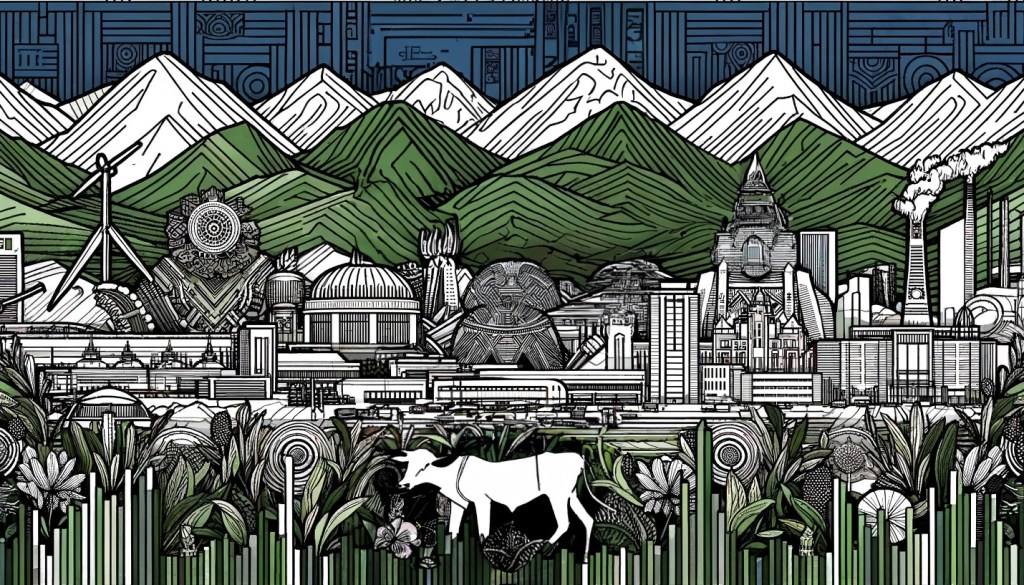
While everyone desperately clung to their New Year’s Resolutions this past January, Lesotho’s Ministry of Trade, Industry and Business Development took a leap into the tech realm by unveiling its AI generated Facebook cover photo. Despite good intentions, the move triggered a social media uproar with local artists and art enthusiasts expressing their distaste and disapproval.
The Ministry was “delighted” to unveil this AI generated initiative to the public, saying that the artwork artistically portrayed “Lesotho’s scenic landscapes and rich cultural heritage,” symbolizing the potential of AI to enhance the country’s economic and cultural narrative. However, reactions on facebook painted a different picture, with concerns about local talent being overshadowed and financial opportunities for artists overlooked, finding the concept foreign and misconceived.
Renowned artist Patrick Kevin Rorke, born in Morija, Lesotho where he still lives and works, has been active as an artist for over forty years and is considered a master of contemporary art in Lesotho, running the best gallery of contemporary art in the country, having also exhibited several times in South Africa and the United States of America.

Image credit: Patrick Kevin Rorke
Rorke found the AI produced cover photo wearisome, and a consequence of decades of neglect towards the arts in Lesotho. Rorke emphasized that AI, while a collaborative tool, cannot replace the deeply human and unique aspects of art creation.
“AI seems to encapsulate everything whereas art made by artists often takes a lot away, leaving just an essential mark or thought… AI seems to cram much of information in, to the point that it is much a traffic jam parading as an art work. The Ministry’s image comes to mind…”, Rorke said.
Rorke urged a reevaluation of the government’s role, advocating for an informed approach. He stressed the need for arts education, vibrant creative communities and open galleries to nurture the growth of the arts in Lesotho.
As an artist Rorkes doesn’t blame the government for the paucity of the arts community in Lesotho, calling artists to see themselves as strong, creative and independent. However, he emphasizes the importance of providing artists and the public with an environment in which arts can thrive.
“What has to happen is arts education. Nobody with any level of visual literacy would look at the Ministry’s image and say: “That is just like Lesotho!” The balance needs to be struck by developing a vibrant and dynamic creative community. Galleries need to be opened, artists need to be developed. The general public needs to be informed and educated so that art becomes a fundamental part of local society.” Rorke said.
The discussion expands to the broader impact of AI on Lesotho’s economy, particularly concerning unemployment. Unemployment has been a persistent issue in Lesotho for years, consistently ranking the country among the top ten African nations with the highest unemployment rates.
According to recent data from the African Development Bank Group (AFDB), youth unemployment stands at 33.2 percent, surpassing the overall unemployment rate of 24 percent in the year 2022. This means that about 554, 400 Basotho, which make up a significant portion of the population, are actively seeking employment but remain without viable opportunities.
Silicon valley experts like Kai-Fu Lee,Chief Executive Officer and Founder of Sinovation Ventures, foresee that AI will cause unprecedented labor force disruptions. Lee believes that about half of all the current jobs will be somewhat or extremely threatened by AI in the next 15 years or so.
“AI will be replacing both the white collar and blue collar jobs and it will be a great symbiotic tool for Doctors, Lawyers and News Reporters, but the white collar jobs are easier to take because they are pure quantitative analytical processes. Like traders, reporters, telesales, telemarketers, customer service, analysts. These can be replaced by the software. To do blue collar work requires hand eye coordination, things that the machines are not yet very good enough to do.” said Lee.
While Lesotho as a developing country tries its level best to keep pace with global technological advancements, it must carefully consider the implications of AI on its labor force and economic landscape. Lihaelo Nkaota, Ministry’s Public Relations Officer, clarified that the AI initiative aimed to create awareness, spark conversations and showcase Lesotho’s progressive approach to technology.
“Our primary goal was to create awareness about AI, initiate conversation on the subject as well as to showcase Lesotho’s forward-looking approach to technology and its application in promoting creative industries as one of the priority sectors and its economic potential.” said Nkaota.
Nkaota assured that the use of the AI wouldn’t overshadow local talent but rather align with the Ministry’s mandate to integrate traditional values with modern innovation. Future plans involve synergizing traditional art forms with technological advancements to provide platforms for artists on both local and international stages.
Lesotho’s participation in global events, such as Doha EXPO 2023 and the upcoming Osaka Expo 2025, demonstrates its commitment to showcasing local talents and fostering international collaborations. Previous projects, including Dubai Expo 2020, Entrepreneur Seed Financing Hub, and local exhibitions, have contributed to community development.
However, as AI continues its exponential growth, Lesotho must consider regulatory frameworks. The European Union’s Artificial Intelligence Act, expected to be enacted in the late 2024 or early 2025 serves as a potential governance model. Lesotho, although without specific AI regulations, recently enacted the Computer and Cyber Security Bill 2023, demonstrating a proactive stance.
According to Hila Mehr, a Harvard Ash Centre and Technology and Democracy Fellow, on his Artificial Intelligence for Citizen Services and Government paper, there are six strategies that can help governments start off on the right foot with AI.
Make AI a part of a goal-based, citizen-centric program, get citizen input, build upon existing resources, be data-prepared and tread carefully with privacy, mitigate ethical risks and avoid AI decision making and “augment employees, do not replace them.”
In addressing concerns about AI’s impact on jobs in the arts, the Ministry emphasizes ongoing monitoring of developments and studies to explore strategies for mitigating negative impacts.
It is beautiful to see the government of Lesotho embrace technology such as AI, and better yet to use it in a way that is inspired and innovative. However, the government has a higher responsibility in ensuring that this technological advancement does not threaten the safety and livelihoods of its citizens. Hopefully, AI regulatory framework is something on the horizon and will work for the people and not against.



 Lesotho Between Headlines
Leave a comment